
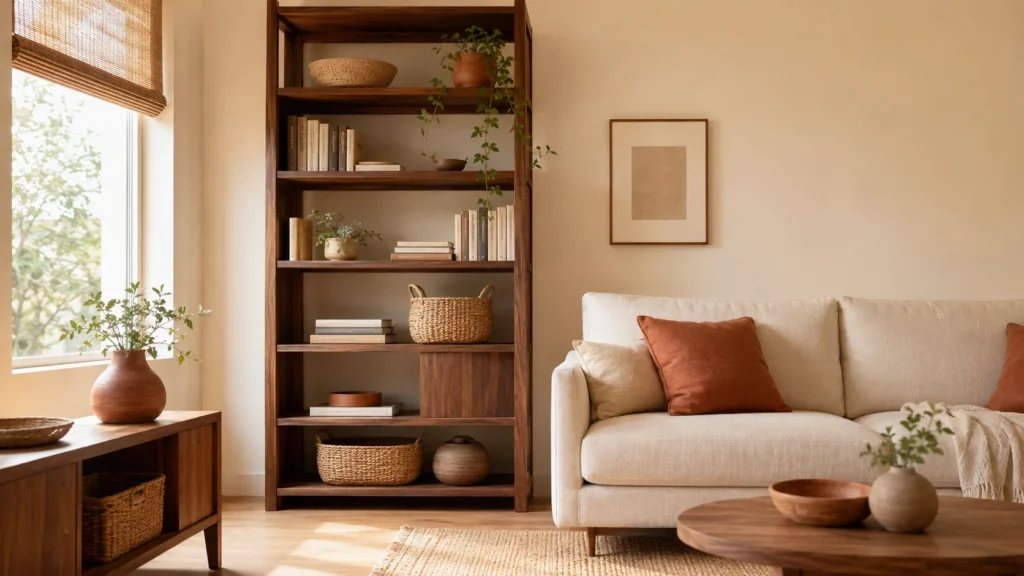
Small living room storage isn’t about owning less — it’s about storing smarter, so a compact space feels calm instead of cramped. The instinct in a small living room is to add less — fewer pieces, nothing bulky, keep it minimal. But minimal and cluttered aren’t opposites. A small room with nowhere to put things looks messier than a large one, because there’s no slack. Every stray object is right there, in a space that’s already tight.
Why Small Living Room Storage Needs to Work Harder
The fix isn’t owning less. It’s storage that works with a small footprint — pieces that go up instead of out, furniture that hides clutter inside itself, and using the corners and walls a bigger room can afford to waste. Done right, a small room can hold just as much and still feel open.
This post contains affiliate links. As an Amazon Associate we earn from qualifying purchases — at no extra cost to you.
Go Up, Not Out
The floor is the one thing you can’t spare in a small room, so the best storage barely touches it. A tall shelving unit holds as much as a wide sideboard while using a fraction of the floor, because it uses the wall height you’re not using anyway.
Add baskets to the lower shelves and you get the small room’s ideal combination: a little open display up top for the few things worth showing, and closed storage below for everything else. Vertical is the single most important instinct in a tight space — every time you can move storage off the floor and onto the wall, the room breathes more.
Make Every Piece Do Two Jobs
In a small room, single-use furniture is a luxury you can’t afford. Every large piece should be pulling double duty — holding your stuff as well as doing its obvious job.
A storage ottoman is seating, a footrest, and a blanket box in one footprint. A coffee table with a drawer or shelf is a surface and a drawer. A storage bench is a seat and a chest. In a small space, these aren’t upgrades — they’re the difference between a room that holds its clutter and one that spills it. We cover the full range in the guide to hidden-storage furniture.
Use the Corners
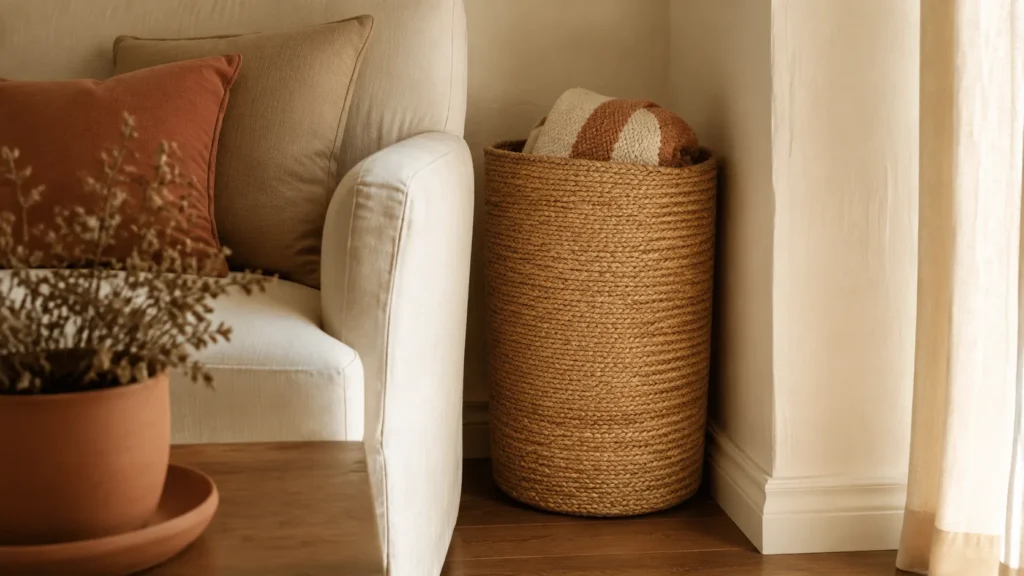
Corners are dead space in most rooms, and in a small one you can’t afford dead space. A tall woven corner basket turns an unused angle into storage for throws or spare cushions. A narrow corner shelf holds books and objects without eating into the walkable floor. A slim console tucked against a wall catches clutter where it enters without blocking the room.
The trick is to look at the parts of the room your eye skips — behind the door, the corner beside the sofa, the wall above eye level — and put storage exactly there, where it costs you nothing.
Choose Closed Over Open
In a large room, a bit of open shelving reads as relaxed. In a small one, it reads as busy — because your eye takes in the whole room at once, and every visible object adds to the sense of clutter. The smaller the room, the more you want storage that’s closed.
Lidded baskets, cabinets with doors, boxes with tops — anything that puts the contents out of sight keeps a small room calm. Save the open display for a very few things you actually want seen, and hide the rest. A small room that hides its clutter can feel more spacious than a large one that shows it.
Keep the Tones Light and Warm
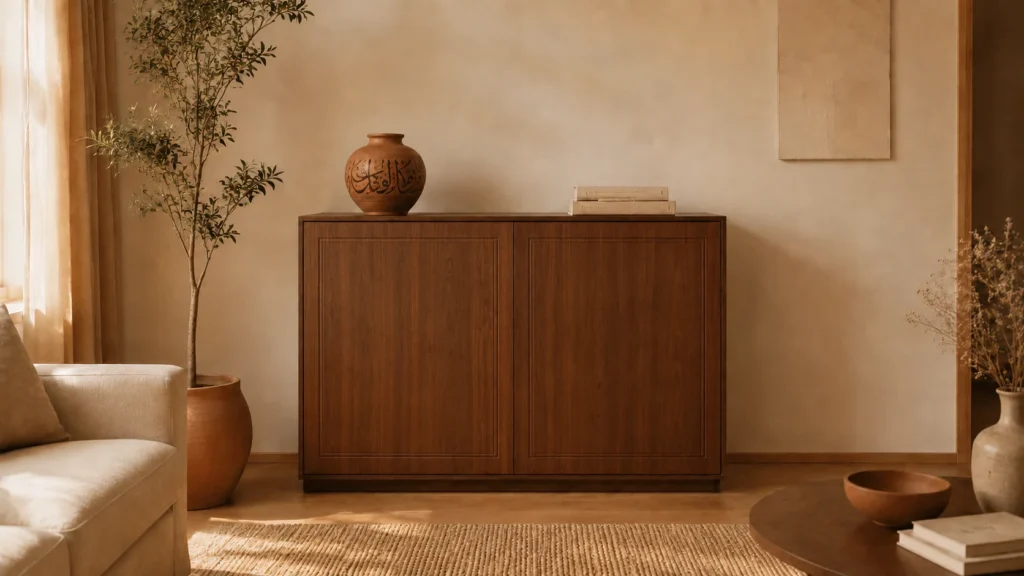
Storage in warm, light neutrals — oat, wheat, natural wood — recedes into a small room instead of crowding it. Heavy dark pieces and cold greys make a tight space feel tighter. Match your storage to the wall and floor tones and it visually disappears, which is exactly what you want when floor and wall space are at a premium.
Where to Start
If your living room is small and cluttered, start by going up: one tall shelving unit with baskets clears more than any floor piece and barely touches the ground. Then make your biggest piece double as storage — a storage ottoman or a coffee table with a drawer — and use a corner you’re currently wasting. Three moves, and a small room can hold everything without feeling full.
Not sure which of these fits your room best? The quiz below reads your space in about two minutes and tells you where to start.